Air Conditioner Repairs Guide: Troubleshooting Common AC Problems Safely
Air Conditioner Repairs Guide: Start With These Safety Rules
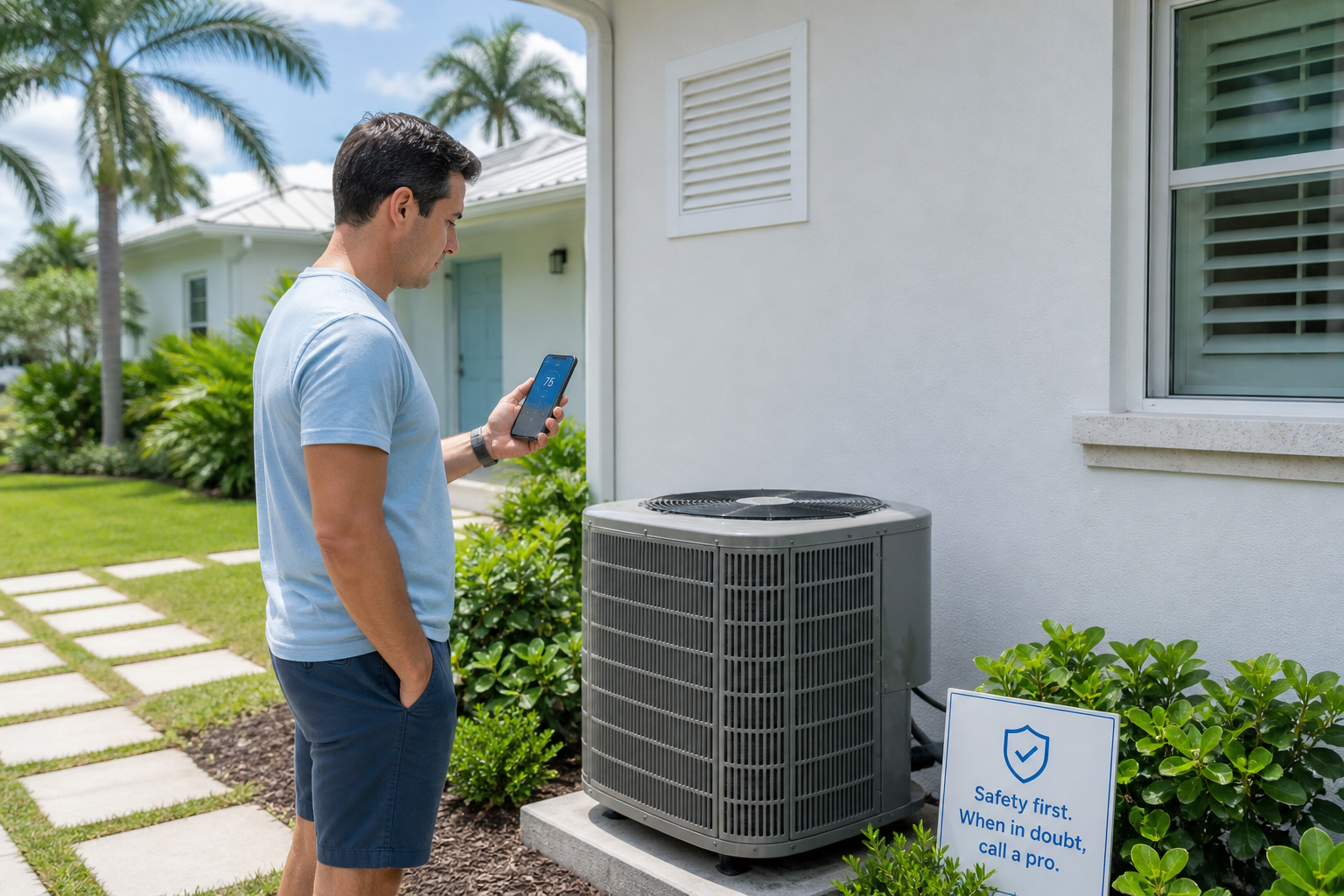
Most common AC problems begin with thermostat settings, airflow restrictions, power interruptions, or outdoor-unit issues. Homeowners can safely check those first, but burning smells, sparks, repeated breaker trips, visible wiring damage, frozen coils, smoke, or water near electrical components should stop DIY troubleshooting immediately and trigger a call to a licensed HVAC technician.
Before you touch anything, remember that an air conditioner combines high-voltage electrical parts, moving motors, refrigerant, sharp metal edges, and water-producing indoor components. Good air conditioner troubleshooting starts with knowing when to step back.
Turn the system off and call for professional air conditioning repair if you notice:
- Burning odor from vents, the air handler, outdoor unit, thermostat, or electrical panel.
- Electrical buzzing, popping, arcing, or sparks near the indoor or outdoor equipment.
- A breaker that trips again after one reset or a breaker that feels hot.
- Visible wiring damage, melted insulation, corrosion at electrical connections, or exposed conductors.
- Loud grinding, screeching, or metal-on-metal noises from a motor, fan, or compressor area.
- Ice on the refrigerant lines, indoor coil, or outdoor lines, especially if the system keeps freezing after thawing.
- Smoke from any HVAC component.
- Water around electrical components, the air handler cabinet, disconnect box, or thermostat wiring.
BlueNest recommends thinking about AC problems in four urgency levels:
- Emergency shutoff: Turn the system off at the thermostat and, if safe, at the breaker or service disconnect. Use this for smoke, burning smells, sparks, repeated breaker trips, water near electrical components, or violent mechanical noise.
- Same-day service: Call promptly for no cooling during extreme heat, a frozen coil, AC running but not cooling, short cycling, hissing sounds, the outdoor unit not starting, or humidity climbing quickly indoors.
- Soon-but-not-emergency: Schedule service for weak airflow, intermittent cooling, rising energy bills, new vibration, uneven room temperatures, or a thermostat that behaves inconsistently after basic checks.
- Monitor and schedule maintenance: If the issue improves after replacing a dirty filter, clearing blocked vents, correcting thermostat settings, or trimming plants around the outdoor unit, monitor performance and schedule maintenance if symptoms return.
In South Florida, long cooling seasons and high humidity make small AC issues feel urgent quickly. A system that struggles for a few hours may leave the home sticky, uncomfortable, and slow to recover. Coastal salt air can also accelerate corrosion on outdoor units, and storm-related power interruptions can expose weak capacitors, control boards, and electrical connections.
Common AC Problems and What They Usually Mean
This quick-reference part of the air conditioner repairs guide helps you match symptoms to safe homeowner checks, likely causes, urgency, and when to schedule air conditioning repair. Use it to narrow the problem, not to open panels, handle refrigerant, bypass controls, or repeatedly reset electrical equipment.
No cooling
- Symptom: The AC runs, but indoor temperature does not drop.
- Safe Homeowner Checks: Confirm thermostat is on cool, lower the setpoint, check the filter, make sure vents and returns are open, and inspect outdoor-unit clearance.
- Possible Causes: Dirty filter, blocked airflow, dirty condenser coil, low refrigerant, failing capacitor, compressor issue, or duct leakage.
- Urgency Level: Same-day service if the home is heating up, especially during Florida summer heat.
- When to Call a Pro: Call if the outdoor unit is not running, air stays warm after basic checks, ice appears, or cooling does not improve.
Weak airflow
- Symptom: Air comes from vents, but pressure is low or rooms cool unevenly.
- Safe Homeowner Checks: Replace or clean the filter, open supply vents, clear furniture from returns, and check for obvious crushed flexible duct if visible without entering unsafe spaces.
- Possible Causes: Dirty filter, blocked returns, blower motor problem, dirty indoor coil, duct leakage, or airflow imbalance.
- Urgency Level: Soon-but-not-emergency unless airflow is nearly stopped or the coil freezes.
- When to Call a Pro: Call if airflow stays weak with a clean filter or if certain rooms never cool properly.
AC will not turn on
- Symptom: Nothing happens when the thermostat calls for cooling.
- Safe Homeowner Checks: Check thermostat display, batteries, mode, schedule, setpoint, and whether the breaker is tripped. Attempt only one breaker reset.
- Possible Causes: Dead thermostat, tripped breaker, condensate safety switch, failed capacitor, control failure, wiring problem, or power interruption.
- Urgency Level: Same-day service in hot or humid weather.
- When to Call a Pro: Call if the breaker trips again, the thermostat is blank after battery replacement, or the outdoor unit hums but will not start.
Warm air from vents
- Symptom: The blower runs, but supply air feels warm or barely cool.
- Safe Homeowner Checks: Confirm cool mode, check fan setting, inspect the filter, and see whether the outdoor fan is running.
- Possible Causes: Thermostat setting error, outdoor-unit failure, low refrigerant, dirty coil, reversing/control issue, or compressor problem.
- Urgency Level: Same-day service if warm air continues.
- When to Call a Pro: Call if the outdoor unit is silent, making a hard-start sound, or the air never cools.
Short cycling
- Symptom: The AC turns on and off quickly without completing a normal cooling cycle.
- Safe Homeowner Checks: Check filter condition, thermostat location, thermostat batteries, and whether vents are blocked.
- Possible Causes: Dirty filter, oversized or aging system, low refrigerant, frozen coil, failing capacitor, control issue, or compressor protection shutdown.
- Urgency Level: Same-day or soon depending on severity.
- When to Call a Pro: Call if rapid cycling continues after basic airflow and thermostat checks.
Unusual noises
- Symptom: Buzzing, grinding, rattling, screeching, clicking, or banging sounds.
- Safe Homeowner Checks: Turn the system off if the noise is loud, metallic, electrical, or new. Check only for obvious debris around the outdoor unit while power is off.
- Possible Causes: Loose panel, failing motor, worn bearing, contactor issue, fan obstruction, compressor issue, or electrical fault.
- Urgency Level: Emergency shutoff for grinding, sparks, buzzing with no start, or smoke.
- When to Call a Pro: Call for any loud, electrical, or mechanical noise that does not stop after the system is shut off.
Odors
- Symptom: Burning, musty, chemical, or stale smells from vents or equipment.
- Safe Homeowner Checks: Replace a dirty filter and confirm the smell is not from household sources. Do not keep running the system if odor seems electrical.
- Possible Causes: Dirty filter, biological growth on damp components, overheated motor, electrical issue, or refrigerant-related concern.
- Urgency Level: Emergency shutoff for burning or smoke; soon for persistent musty odor.
- When to Call a Pro: Call immediately for burning odors or if the smell worsens when the AC starts.
Frozen coil or icy refrigerant line
- Symptom: Ice appears on indoor components, copper lines, or the outdoor connection area.
- Safe Homeowner Checks: Turn cooling off, set fan to on if the system allows, replace a dirty filter, and allow ice to thaw before restarting.
- Possible Causes: Restricted airflow, dirty filter, dirty coil, blower issue, duct restriction, or low refrigerant.
- Urgency Level: Same-day service if ice returns.
- When to Call a Pro: Call if the system freezes again, airflow remains weak, or cooling performance is poor.
High indoor humidity
- Symptom: The home feels sticky even when the thermostat temperature looks close to normal.
- Safe Homeowner Checks: Make sure the fan is set to auto, replace the filter, and confirm doors and windows are closed.
- Possible Causes: Oversized system, short cycling, weak airflow, dirty coil, duct leakage, refrigerant issue, or heavy moisture load.
- Urgency Level: Soon-but-not-emergency unless cooling also fails.
- When to Call a Pro: Call if humidity stays high for more than a day of normal operation or the system runs constantly without comfort improving.
Thermostat problems
- Symptom: Blank display, wrong temperature reading, schedule confusion, or system not responding.
- Safe Homeowner Checks: Replace batteries, verify cool mode, review programmed schedules, and make sure the thermostat is not in direct sunlight or near a heat source.
- Possible Causes: Dead batteries, poor placement, wiring issue, failed thermostat, or control-board problem.
- Urgency Level: Soon or same-day if the AC cannot run.
- When to Call a Pro: Call if the thermostat is blank after battery replacement or if changing settings does not trigger operation.
Breaker trips
- Symptom: The AC breaker trips during startup or operation.
- Safe Homeowner Checks: Try one reset only if there is no burning smell, water, smoke, or visible damage.
- Possible Causes: Electrical overload, shorted component, failing motor, compressor issue, damaged wiring, or capacitor failure.
- Urgency Level: Emergency shutoff if it trips again.
- When to Call a Pro: Call after a second trip or any sign of electrical heat, buzzing, or damage.
Rising energy bills
- Symptom: Utility costs increase while comfort gets worse or runtimes get longer.
- Safe Homeowner Checks: Replace the filter, clear outdoor-unit clearance, check thermostat schedules, and compare recent weather and usage.
- Possible Causes: Dirty coils, restricted airflow, duct leakage, aging components, low refrigerant, thermostat issue, or declining efficiency.
- Urgency Level: Monitor and schedule maintenance unless comfort is failing.
- When to Call a Pro: Call if bills rise along with weak cooling, long runtimes, short cycling, or humidity problems.
Many HVAC best practices emphasize clean filters and unrestricted airflow because restricted airflow can reduce comfort, stress equipment, and lower efficiency. In practical terms, a clogged filter is one of the simplest problems to fix and one of the easiest to overlook.
Safe Air Conditioner Troubleshooting Before Calling for Air Conditioning Repair
Before calling for air conditioning repair, homeowners can safely check thermostat settings, the air filter, vent airflow, one-time breaker status, outdoor-unit clearance, and whether indoor and outdoor units are operating. Stop immediately if you notice electrical odors, sparks, repeated breaker trips, ice, smoke, or water near wiring.
Step 1: Check the thermostat first
The thermostat is the control center, and small setting errors can look like major AC failures. Start here before assuming the equipment is broken.
- Mode: Make sure it is set to cool, not heat, off, or fan only.
- Setpoint: Set the temperature at least a few degrees below the current indoor temperature.
- Schedule: Review programmed settings, vacation modes, eco settings, or smart thermostat routines.
- Fan setting: Use auto for normal cooling and humidity control. Fan on can circulate air between cooling cycles and may make humidity feel worse in Florida homes.
- Batteries: Replace batteries if the display is dim, blank, or inconsistent.
- Display: A blank thermostat after new batteries may point to a power, wiring, float switch, or control problem.
If the thermostat clicks or shows cooling demand but the equipment does not respond, move to airflow and power checks. Do not remove the thermostat from the wall unless you know what you are doing; low-voltage wiring mistakes can create new problems.
Step 2: Inspect the air filter, vents, and returns
A dirty filter can starve the system for air. That can lead to weak airflow, poor cooling, longer runtimes, frozen coils, and higher energy use.
- Find the filter location: It may be at the return grille, air handler, or filter rack.
- Check the date: If the filter has not been changed recently, replace it with the correct size and type.
- Look for heavy dust: A filter that is gray, matted, or bowed inward is likely restricting airflow.
- Open supply vents: Do not close many vents to redirect air; that can increase system pressure and reduce performance.
- Clear returns: Move furniture, rugs, boxes, and curtains away from return grilles.
- Listen for strain: Whistling returns or rattling grilles can signal restricted airflow.
Do not remove equipment panels, reach into the blower compartment, or touch the coil. If the filter is clean and airflow is still weak, the problem may involve the blower, indoor coil, duct system, or refrigerant charge.
Step 3: Confirm power carefully
Power interruptions are common after storms, utility flickers, and heavy summer electrical demand. Still, repeated breaker trips are not normal and should never be treated as a reset-and-forget problem.
- Check the breaker: Look for a tripped AC breaker in the electrical panel.
- Reset once only: If there is no burning smell, smoke, visible damage, water, or buzzing, you may try one reset.
- Stop after a second trip: If the breaker trips again, leave it off and call a licensed HVAC technician.
- Check the thermostat after power returns: Some thermostats take a few minutes to restart.
- Wait for built-in delays: Many systems have anti-short-cycle delays that prevent immediate restart.
Never tape a breaker, hold it in place, oversize it, or keep resetting it. Breakers trip to protect the circuit. If the AC causes repeated trips, the issue may involve a failing motor, compressor, capacitor, contactor, wiring fault, or electrical overload.
Step 4: Check outdoor-unit clearance
The outdoor condenser needs room to reject heat. In South Florida, plants grow quickly, palm debris collects fast, and storm debris can block airflow.
- Clear leaves and loose debris from around the unit while it is off.
- Trim vegetation so the unit has open airflow around it.
- Look for blocked coil surfaces from grass clippings, lint, or dirt.
- Do not pressure wash coils or bend fins with tools.
- Do not reach through the grille or touch the fan area.
If the outdoor fan is not spinning while the indoor blower runs, or if the unit hums but will not start, turn the system off and call for AC repair.
Step 5: Compare indoor and outdoor operation
A split AC system needs both sides working. If the indoor blower runs but the outdoor unit does not, you may feel warm air. If the outdoor unit runs but indoor airflow is weak, the issue may be indoors.
- Indoor unit running, outdoor unit off: Possible capacitor, contactor, power, control, or compressor issue.
- Outdoor unit running, weak indoor air: Possible filter, blower, coil, or duct problem.
- Both units running, poor cooling: Possible dirty coils, refrigerant issue, duct leakage, airflow problem, or aging equipment.
- Neither unit running: Possible thermostat, breaker, safety switch, or control issue.
AC Repair Guide: Problems That Need a Licensed HVAC Technician
Some AC problems move beyond homeowner hvac repair tips. If the issue involves refrigerant, high-voltage electrical parts, motors, capacitors, compressor symptoms, recurring frozen coils, or repeated performance failures, professional air conditioning repair is the safer and more reliable path.
Refrigerant problems
Low refrigerant is not like low fuel in a car. In a sealed system, low refrigerant usually means there may be a leak or an installation-related issue. Homeowners should not add refrigerant, use DIY recharge kits, or vent refrigerant.
Call a licensed HVAC technician for possible refrigerant issues such as:
- Hissing or bubbling sounds near refrigerant lines or coils.
- Oily residue around fittings, coils, or line connections.
- Ice on the indoor coil or suction line that returns after thawing.
- AC running constantly but never reaching the thermostat setpoint.
- Warm air from vents while airflow seems normal.
Refrigerant handling is regulated, and technicians who work with refrigerants are expected to follow EPA Section 608 certification requirements. A proper repair may include leak detection, recovery, evacuation, weighing in the correct charge, and verifying system performance.
Electrical and control failures
Capacitors, contactors, relays, control boards, wiring, and compressor circuits are professional-only areas. These parts can hold or carry dangerous voltage even when the system is not cooling properly.
Call for service if you notice:
- The outdoor unit hums but the fan does not start.
- The AC tries to start, clicks, and shuts off.
- Breakers trip during startup or shortly after the system runs.
- You hear electrical buzzing from the outdoor unit or air handler.
- The thermostat calls for cooling but equipment response is inconsistent.
- The system works after a storm but then fails again.
In coastal Florida, corrosion can affect electrical terminals, contactors, and outdoor components. After lightning, brownouts, or power flickers, a weak capacitor or control board may fail suddenly.
Mechanical and airflow component failures
Motors and moving parts can fail gradually or suddenly. A homeowner may hear noise, feel weak airflow, or notice that the system runs longer than usual before the failure becomes obvious.
Professional diagnosis is needed for:
- Blower motor failure or inconsistent blower speed.
- Condenser fan motor failure.
- Compressor hard-start symptoms or failure to start.



Leave a reply