Preventive AC Maintenance Guide: Homeowner Checklist, Tune-Up Tasks, and When to Call a Pro
Quick Answer: What Preventive AC Maintenance Includes
Preventive AC maintenance includes routine inspection, cleaning, tightening, testing, calibration, and documentation that keeps your air conditioner cooling safely and efficiently before small problems become peak-season breakdowns. It is more than changing the filter; it covers airflow, coils, controls, electrical components, condensate drainage, and system performance.
A practical preventive AC maintenance guide should separate low-risk homeowner tasks from licensed HVAC work. Homeowners can usually handle visible air conditioning maintenance such as filter checks, thermostat settings, vent access, and clearing debris around the outdoor unit. A trained technician should handle electrical testing, refrigerant performance checks, motor diagnostics, deeper cleaning, and sealed-system service.
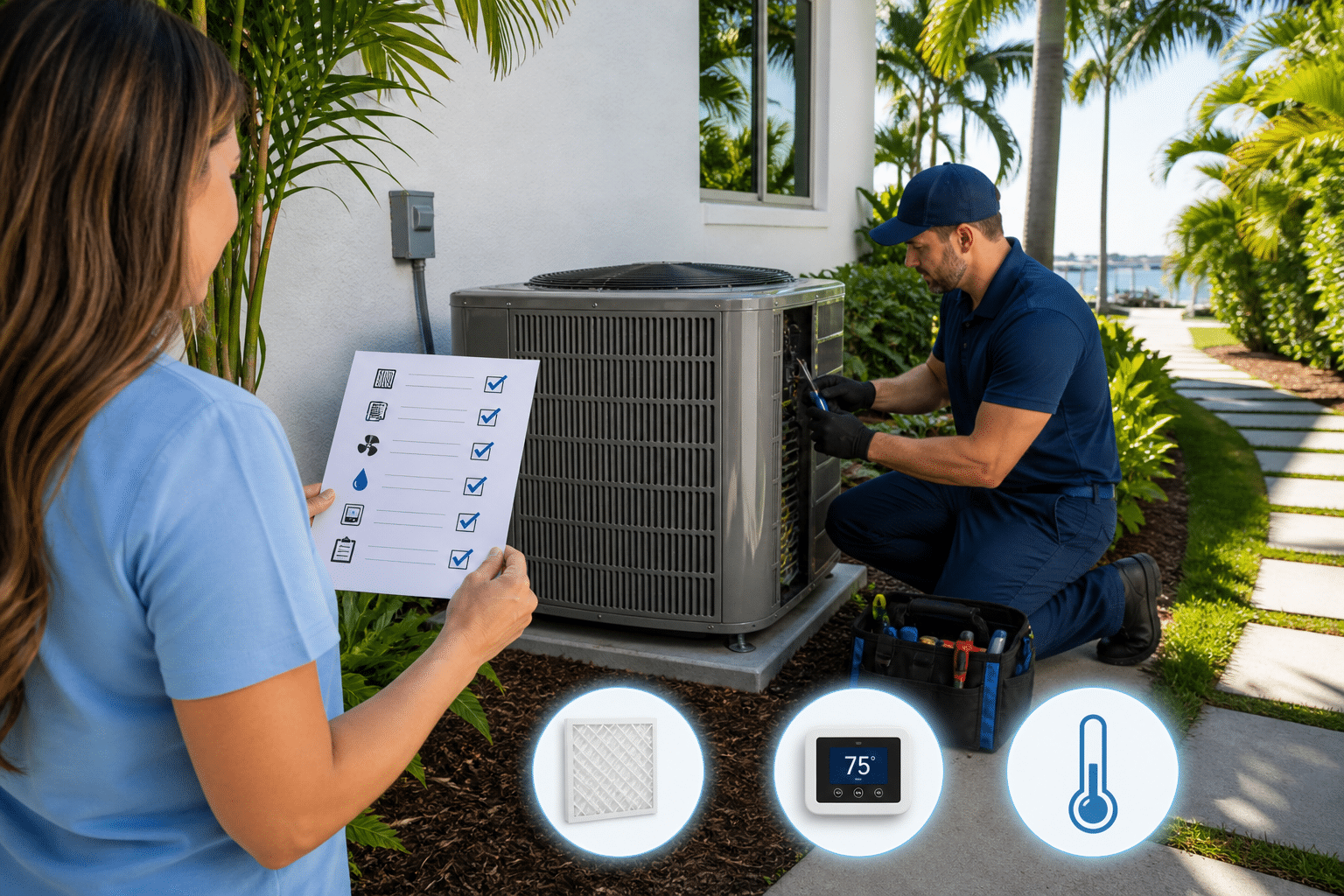
The core AC maintenance checklist includes:
- Air filter checks: Inspect the filter monthly during heavy-use seasons and replace it when dirty.
- Thermostat testing: Confirm the system is in cooling mode, the schedule is reasonable, and batteries are fresh if needed.
- Airflow checks: Make sure supply registers and return grilles are open and not blocked by furniture, rugs, curtains, or storage.
- Outdoor condenser clearing: Remove leaves, grass clippings, branches, and stored items around the outdoor unit.
- Coil inspection: Look for visible dirt or blocked airflow; leave deeper coil cleaning to a professional when panels or chemicals are involved.
- Condensate awareness: Watch for water stains, algae growth, drain backups, musty odors, or overflow pan issues.
- Electrical testing: Have a technician test capacitors, contactors, wiring, disconnects, relays, and safety controls.
- Refrigerant performance review: Have a technician evaluate refrigerant pressures and temperature behavior when performance suggests a problem.
- Documentation: Keep service dates, filter sizes, repair notes, and tune-up reports in one place.
Clean filters matter. The Department of Energy notes that replacing a dirty, clogged filter with a clean one can lower air conditioner energy consumption by 5% to 15%. That makes filter care one of the simplest and most valuable air conditioner maintenance tips for homeowners.
Printable AC Maintenance Checklist: DIY and Professional Tasks
Use this checklist to see what you can safely do yourself, what belongs in a professional AC tune up, how often each task matters, and why it protects cooling performance. For a printed version, copy these items into your home maintenance binder or property inspection log.
DIY AC Maintenance Checklist
- Task: Inspect or replace the air filter. DIY or Pro: DIY. How often: Check monthly during cooling season; replace when dirty or as the filter label recommends. Why it matters: A dirty filter restricts airflow, increases runtime, and can raise energy use. ENERGY STAR commonly advises checking filters monthly, especially during heavy heating or cooling use.
- Task: Confirm thermostat settings. DIY or Pro: DIY. How often: Monthly and before summer. Why it matters: Incorrect modes, dead batteries, or poor schedules can cause comfort complaints that look like equipment problems.
- Task: Keep supply and return vents open. DIY or Pro: DIY. How often: Monthly and after rearranging furniture. Why it matters: Blocked vents reduce comfort, strain airflow, and can create uneven temperatures.
- Task: Clear debris around the outdoor condenser. DIY or Pro: DIY for light, visible debris. How often: Monthly, after storms, and after lawn service. Why it matters: The outdoor unit needs open airflow to release heat properly.
- Task: Look for visible access issues. DIY or Pro: DIY. How often: Monthly or before service visits. Why it matters: Stored boxes, plants, fencing, or clutter can block service access and airflow.
- Task: Listen for unusual noises. DIY or Pro: DIY observation; pro diagnosis if noise continues. How often: Whenever the system starts or runs. Why it matters: Rattling, buzzing, grinding, or repeated clicking can point to loose parts, electrical issues, or motor problems.
- Task: Watch for weak airflow or rooms that are suddenly warmer. DIY or Pro: DIY observation; pro diagnosis if it does not improve after filter and vent checks. How often: Ongoing. Why it matters: Weak airflow can signal filter restriction, blower trouble, duct issues, coil problems, or refrigerant-related performance concerns.
- Task: Track service records. DIY or Pro: DIY. How often: Every filter change, repair, and tune-up. Why it matters: Records help homeowners, property managers, and technicians spot recurring issues and document maintenance history.
Professional HVAC Preventive Maintenance Checklist
- Task: Inspect evaporator and condenser coils; clean when needed. DIY or Pro: Pro. How often: At least annually, more often in dusty, coastal, or high-use conditions. Why it matters: Dirty coils reduce heat transfer, which can make the system run longer and cool less effectively.
- Task: Test capacitors, contactors, wiring, and disconnects. DIY or Pro: Pro. How often: Annually. Why it matters: Worn or loose electrical components can cause hard starts, intermittent operation, or safety concerns.
- Task: Evaluate refrigerant performance. DIY or Pro: Pro. How often: During annual tune-ups or when cooling performance changes. Why it matters: Refrigerant systems are sealed; low refrigerant usually indicates a leak or another issue that needs diagnosis.
- Task: Check blower and fan operation. DIY or Pro: Pro. How often: Annually. Why it matters: Proper fan and blower operation supports airflow, comfort, and coil performance.
- Task: Inspect condensate drainage. DIY or Pro: Pro for drain testing and clearing; DIY for visible water awareness. How often: Annually and whenever leaks or musty odors appear. Why it matters: Clogged condensate lines can cause water damage, shutdowns, and humidity problems.
- Task: Measure temperature split and system cycle behavior. DIY or Pro: Pro. How often: During a professional AC tune up. Why it matters: Measurements help verify whether the system is cooling within expected operating conditions.
- Task: Inspect safety controls and service panels. DIY or Pro: Pro. How often: Annually. Why it matters: Safety devices and secure panels help protect equipment and occupants.
Monthly and Pre-Summer Air Conditioning Maintenance Tasks for Homeowners
The most important homeowner air conditioning maintenance tasks are monthly filter checks, clear airflow paths, thermostat verification, outdoor condenser clearance, and early attention to unusual sounds or weak airflow before heavy summer runtime. These simple habits help prevent comfort problems and reduce strain during the hottest weeks of the year.
Start inside the home. Check the air filter and replace it when it looks dirty, clogged, or past its recommended service life. If you have pets, dust, frequent guests, renovation activity, or a long cooling season, inspect it more often. In South Florida and other humid climates where AC systems may run for much of the year, monthly filter checks are especially important.
Next, walk each room and look at the registers and returns. Supply registers should be open and unobstructed. Return grilles should not be blocked by sofas, beds, cabinets, rugs, laundry baskets, or storage bins. A clean filter cannot do its job if the system cannot move air freely through the home.
Thermostat settings deserve a quick review. Confirm the system is set to cooling mode, the target temperature is realistic, and the schedule matches how the home is used. If you have a smart thermostat, check that vacation modes, energy-saving schedules, and occupancy settings are not fighting your comfort needs. If the thermostat uses batteries, replace them before the display fades or the system becomes unreliable.
Outdoor condenser care is another high-value DIY task. Remove leaves, palm fronds, mulch, grass clippings, branches, and storm debris from around the unit. Do not stack pool supplies, patio furniture, trash bins, tools, or planters against the condenser. The outdoor unit needs room to breathe and enough access for a technician to service it safely.
Before clearing debris close to the equipment, use caution. For light cleanup around the unit, avoid reaching into the cabinet or touching wiring, fan blades, refrigerant lines, or electrical components. If debris is inside the cabinet, the fan guard must be removed, or the unit appears damaged, call a professional.
Before summer heat arrives, run a short cooling test on a mild day. Set the thermostat a few degrees below room temperature and let the system run. Listen for unusual noises, check for steady airflow at several registers, and make sure the outdoor unit starts and runs normally. This is not a replacement for a professional AC tune up, but it can help you catch obvious problems before appointment calendars fill.
Your pre-summer checklist should include:
- Check and replace the air filter if needed.
- Confirm all supply registers and return grilles are open and clear.
- Review thermostat programming and cooling mode.
- Clear debris around the outdoor condenser.
- Look for signs of water near the indoor unit or drain pan.
- Listen for buzzing, rattling, grinding, squealing, or repeated clicking.
- Review last year’s maintenance notes and repair history.
- Schedule a professional AC tune up before peak heat and humidity.
Remember the filter benefit: replacing a dirty, clogged filter with a clean one can lower AC energy consumption by 5% to 15%, according to Department of Energy guidance. It is a small step with a measurable impact on system performance.
What a Professional AC Tune Up Should Include
A professional AC tune up should go beyond a quick visual check by inspecting, cleaning, testing, measuring, and documenting the system’s electrical, airflow, coil, refrigerant-performance, thermostat, blower, fan, and condensate components. The goal is to verify safe operation, improve reliability, and catch developing problems early.
A strong tune-up starts with inspection and cleaning. The technician should check the evaporator coil and condenser coil for dirt, biological buildup, corrosion, or blocked airflow. Coils are central to heat transfer. When evaporator or condenser coils are dirty, airflow and coil performance suffer, which can make the system run longer to satisfy the thermostat.
The technician should also review the blower assembly, fan operation, cabinet condition, and access panels. Indoor and outdoor units must move air properly. If the blower wheel is dirty, the fan motor is weak, or the outdoor coil is packed with debris, the system may cool poorly even if the thermostat and filter look fine.
Electrical and safety checks are a key reason to hire a licensed HVAC professional. A proper AC tune up may include testing capacitors, contactors, wiring, disconnects, amperage, relays, and safety controls. Loose connections, weak capacitors, or worn contactors can lead to hard starting, short cycling, intermittent operation, or equipment failure during peak heat.
Performance testing is equally important. A technician may measure temperature split, review airflow indicators, verify thermostat operation, observe cycle behavior, and evaluate refrigerant performance using appropriate tools. This does not mean refrigerant should automatically be added. Refrigerant is not a fuel that gets used up. If the system is low, the cause should be diagnosed.
A professional tune-up should also include condensate drainage inspection. In humid climates, the AC removes a significant amount of moisture from indoor air. A clogged drain line, algae buildup, damaged pan, or failed float switch can cause shutdowns or water damage. This is especially important in South Florida, where humidity and long runtimes make drainage problems more common.
Ask for documentation after the service. A useful tune-up report may include:
- Filter size and condition.
- Thermostat operation notes.
- Coil condition and cleaning recommendations.
- Electrical component readings or observations.
- Blower and fan operation notes.
- Condensate drain condition.
- Refrigerant performance findings.
- Recommended repairs, if any.
- Date of service and technician notes.
Good documentation protects homeowners and property managers. It helps prove routine HVAC preventive maintenance was completed, supports warranty conversations, and makes it easier to compare system condition over time.
DIY vs Professional HVAC Preventive Maintenance: What to Handle and What to Avoid
Homeowners can support HVAC preventive maintenance with basic cleaning, airflow checks, filter changes, thermostat review, outdoor debris removal, and maintenance records. Licensed professionals should handle electrical testing, refrigerant diagnostics, deeper coil cleaning, motor and blower inspection, safety controls, duct measurements, and performance verification.
DIY vs Pro Comparison
- Maintenance area: Air filter. Safe DIY task: Check monthly and replace when dirty. Professional task: Confirm airflow and system impact if filters clog quickly. When to call a pro: Filters become dirty unusually fast, airflow stays weak, or the system freezes.
- Maintenance area: Thermostat. Safe DIY task: Confirm cooling mode, schedule, temperature setting, and batteries. Professional task: Test calibration, wiring, and system response. When to call a pro: The system does not respond, short cycles, or temperature readings seem inaccurate.
- Maintenance area: Vents and returns. Safe DIY task: Keep registers open and move furniture away from grilles. Professional task: Measure airflow and evaluate duct restrictions. When to call a pro: Some rooms stay hot, airflow is uneven, or ducts make loud popping or whistling sounds.
- Maintenance area: Outdoor condenser. Safe DIY task: Remove leaves, grass clippings, and stored items around the unit. Professional task: Open the cabinet, clean coils properly, inspect fan and electrical components. When to call a pro: Debris is inside the unit, the fan is noisy, or the cabinet appears damaged.
- Maintenance area: Coils. Safe DIY task: Look for visible blockage or dirt. Professional task: Clean evaporator or condenser coils when equipment must be opened or cleaning products are required. When to call a pro: Cooling is weak, the unit runs constantly, or coils appear heavily soiled.
- Maintenance area: Refrigerant. Safe DIY task: None beyond observing symptoms. Professional task: Diagnose refrigerant performance, test for leaks, and service the sealed system. When to call a pro: Ice forms, cooling drops, the system runs nonstop, or a technician previously noted low refrigerant.
- Maintenance area: Electrical components. Safe DIY task: Keep the area accessible and report buzzing or burning smells. Professional task: Test capacitors, contactors, wiring, disconnects, relays, and amperage. When to call a pro: Breakers trip, lights dim when the unit starts, or the system clicks but does not run.
- Maintenance area: Condensate drainage. Safe DIY task: Watch for visible water, stains, algae, or musty odors. Professional task: Clear drain lines, inspect pans, and test float switches. When to call a pro: Water appears near the indoor unit or the system shuts off unexpectedly.
- Maintenance area: Records. Safe DIY task: Track filter changes, tune-ups, repairs, and symptoms. Professional task: Provide service documentation and repair recommendations. When to call a pro: Patterns appear, such as repeated capacitor failures, drain clogs, or low-cooling complaints.
Electrical, refrigerant, and sealed-system service should be performed by trained professionals. These areas involve safety risk, specialized tools, environmental handling requirements, and manufacturer procedures. Attempting them as DIY repairs can create hazards and may affect equipment warranties.
How Often to Schedule Air Conditioning Maintenance and Improve Performance
Most homes should schedule professional air conditioning maintenance at least once per year, ideally before peak heat. Homes with heavy use, pets, older equipment, rental occupancy, coastal exposure, or South Florida humidity may benefit from twice-yearly HVAC preventive maintenance to support reliability and comfort.
For most homeowners, the basic schedule is simple: check filters monthly during heavy-use seasons, replace filters when dirty, keep vents and returns open, clear the outdoor condenser area, and schedule a professional AC tune up annually. The best time to book is before the hottest part of the year, when service calendars are less crowded and small issues can be corrected before they become urgent.
Some homes need more attention. Consider twice-yearly maintenance if:
- Your AC runs nearly year-round.
- You live in a humid climate with long cooling seasons.
- The home is near coastal salt air, which can accelerate corrosion.
- You have pets that shed.
- The property has high dust, construction activity, or frequent occupants.
- The system is older and has a history of repairs.
- The property is a rental and must stay inspection-ready for tenants or guests.
- The system serves a home office, short-term rental, or other space where downtime is costly.
Performance improvement is usually the result of consistent small habits, not one big fix. Keep filters clean, avoid blocking returns, maintain outdoor clearance, use a reasonable thermostat schedule, and keep service records. If the system is struggling, do not keep lowering the thermostat and hoping it catches up. Weak airflow, long runtimes, ice, repeated breaker trips, water around the indoor unit, or warm air from vents are signs to call a professional.
These air conditioner maintenance tips can help extend reliability:
- Buy the correct filter size and type for your system.
- Write the installation date on the filter frame.
- Set a monthly reminder during cooling season.
- Keep return grilles clean and unobstructed.
- Trim plants around the outdoor unit while maintaining practical airflow and service clearance.
- Schedule maintenance before the first major heat wave.
- Save tune-up reports, invoices, and repair recommendations.
- Address small noises, odors, leaks, and airflow changes early.
Again, the filter is one of the easiest wins. Replacing a dirty, clogged filter with a clean one can lower AC energy consumption by 5% to 15%, according to Department of Energy guidance. For homeowners and property managers, that makes filter care a practical first step in every preventive ac maintenance guide.
FAQ
What is preventive AC maintenance?
Preventive AC maintenance is the routine inspection, cleaning, testing, tightening, calibration, and documentation of an air conditioning system before it fails. It includes homeowner tasks such as filter changes and airflow checks, plus professional service such as electrical testing, coil inspection, condensate review, blower checks, and refrigerant performance diagnostics.
What should be included in an AC maintenance checklist?
An AC maintenance checklist should include filter inspection, thermostat verification, open vents and returns, outdoor condenser clearance, visible coil and debris checks, condensate awareness, unusual-noise monitoring, service-record tracking, professional electrical testing, coil cleaning when needed, blower and fan inspection, and refrigerant performance evaluation.
How often should an air conditioner be serviced?
Most air conditioners should be professionally serviced at least once per year, preferably before peak cooling season. Systems with heavy use, pets, older equipment, rental occupancy, coastal exposure, high humidity, or year-round runtime may benefit from twice-yearly HVAC preventive maintenance.
What maintenance can I do myself on my AC unit?
You can safely inspect and replace the air filter, check thermostat settings, keep vents and returns open, move furniture


Leave a reply